 Recall
How to transcribe LINE calls: Call Recording’s conditions and keeping calls on a Mac
LINE’s 1:1 calls can be recorded and transcribed with Call Recording in LINE Labs. We cover which calls it works for, what the other person sees, and where files are saved, plus ways to transcribe video calls, group calls, and calls on LINE for Mac.
The short answer: for 1:1 voice calls on a phone, try LINE’s Call Recording first
If you want text from a 1:1 voice call in LINE on your phone, try LINE’s Call Recording first. It has been rolling out in LINE Labs since October 27, 2026, and it records the call and transcribes Japanese speech inside LINE. The other person is told, by voice and on screen, that the call is being recorded.
Some calls are not covered, though. Group calls are excluded, and video calls are only recorded, not transcribed. LINE’s guide covers the smartphone app (iOS and Android) and says nothing about the PC version. For those calls, record first and transcribe the file, or take the call in LINE for Mac and use a tool such as Recall that turns what your Mac hears into text.
This article is written by KOROMO K.K., the developer of Recall, a transcription app for Mac. Our own product is among the options, so please read with that in mind. Details of LINE and other products were checked on their official pages on November 7, 2026. We haven’t compared Call Recording and Recall on the same calls, so we don’t rank their accuracy.
Three ways to turn a LINE call into text
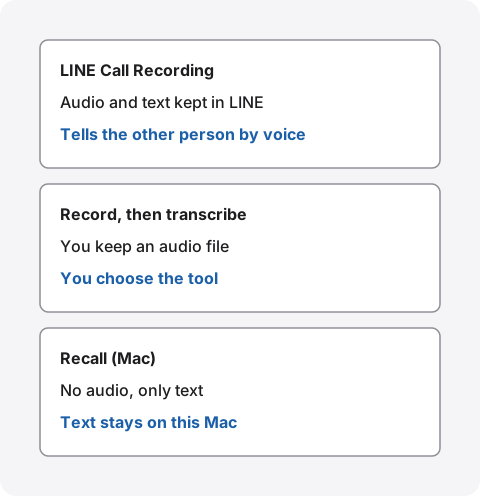
There are three ways: use LINE’s Call Recording, record first and transcribe the file, or take the call in LINE for Mac and transcribe it on the Mac. Which one fits depends less on accuracy than on which device you call from and what kind of call it is.
| Calls it works for | What is kept, and where | |
|---|---|---|
| LINE’s Call Recording | 1:1 calls in LINE on a phone. Transcription only for voice calls between accounts registered in Japan | Text stays in the LINE app. Audio and video recordings are sent to Keep Memo automatically, and what is sent no longer stays in the app |
| Record first, then transcribe the file | Any call you can turn into a file, such as a recorded video call or audio recorded on a Mac | The audio or video file stays with you. The text stays in whichever tool you give the file to |
| Transcribe what your Mac hears (Recall) | Calls in LINE for Mac. Group and video calls become text too, if you hear them on your Mac | No audio is kept, and the text stays on your Mac |
Call Recording’s strength is that everything happens inside LINE and the other person knows it is recording. Its limit is the narrow set of calls it covers. Transcribing on a Mac works for any call, but keeps only what you heard, on your own machine.
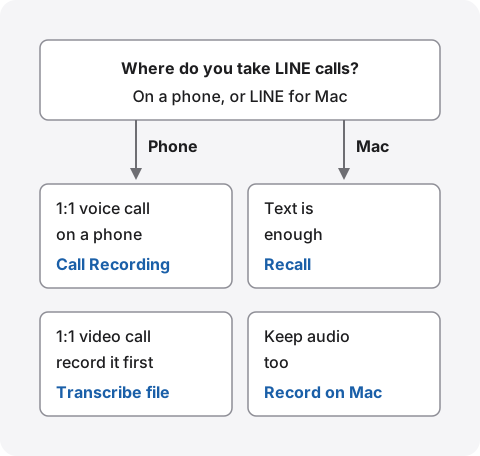
If you’re unsure, start by deciding whether you take the call on a phone or on a Mac.
What LINE’s Call Recording does
Call Recording records LINE’s 1:1 calls and, for Japanese voice calls, transcribes them too. According to LY Corporation’s announcement (in Japanese), it began rolling out in LINE Labs on October 27, 2026. The conditions below come from the Call Recording page of LINE’s user guide (in Japanese, updated October 28, 2026).
Which calls, and what it needs
- 1:1 calls only: Voice and video calls are covered. It can’t be used in group calls
- LINE on a phone: Version 26.16.0 or later on iOS and Android. The guide doesn’t say whether it works in the PC version
- Transcription only for Japanese voice calls: It covers 1:1 voice calls between LINE accounts registered in Japan; video calls are only recorded. Recording itself works between accounts in the same country or region
- Length: About 1 hour for voice calls, about 20 minutes for video at standard quality, and about 50 minutes at light quality. It stops automatically past that. Calls shorter than 3 seconds aren’t recorded
- Cost: While it’s in LINE Labs, every LINE user can try it for free. The announcement says that after LINE Labs, it is planned to become a benefit for LYP Premium members from this winter onward
LINE says LINE Labs features may become unavailable without notice. Keep that in mind if you plan to rely on it, for work records for example.
How to turn it on
- In LINE, open Settings from Home, and turn on Call Recording under LINE Labs
- If you also want transcripts, turn on call transcription before the call starts, under Calls, then Call Recording, in Settings. The first time, you download the transcription feature and agree to the notes shown
- During a call, tap the button to start recording, and audio or video recording begins
- To stop, tap pause. Ending the call without pausing also ends the recording
LINE’s guide says to turn on call transcription before starting the call. On a day with a call you want in text, check the setting beforehand so you don’t miss it.
What the other person sees
When recording starts, both sides hear a voice message that recording has begun, and the screen shows that the call is being recorded. The person being recorded sees that the other side is using Call Recording. When it stops, both sides hear that recording has ended. When nobody is recording, nothing appears on the other person’s screen. In other words, this feature can’t record someone without them knowing.
Where files are saved, and when they disappear
When recording ends, audio and video recordings are sent to Keep Memo automatically, though depending on the connection or settings they may not be. Data sent to Keep Memo doesn’t stay in the LINE app. Transcripts aren’t sent automatically, so send them to Keep Memo yourself if you want them there. Recordings and transcripts can be viewed on the recording files screen in the LINE app, and saved to the device.
Watch out for when they disappear. According to the guide, data inside the app is deleted when you change phones, or delete and reinstall LINE. If you turn Call Recording off in LINE Labs, the recording files screen no longer appears either. Turn it back on and it appears again. Send important transcripts to Keep Memo, or save them to the device.
The pages we checked didn’t say whether Call Recording transcribes on the phone or on LINE’s servers. If you discuss work, check LINE’s information before you use it.
Calls that Call Recording doesn’t transcribe
Video calls, group calls, and calls in the PC version of LINE don’t become text with Call Recording. For these, record the call to make an audio file and give it to a tool that transcribes files, or turn what your Mac hears straight into text.
1:1 video calls: transcribe the recording
Call Recording can record a 1:1 video call. Save the recording to your device and give it to a tool that transcribes audio files. For example, LINE WORKS AiNote says on its product page that it can create records from audio data. Your file goes to the provider’s service, though, so check the free plan’s conditions and how data is handled on its official pages.
If you don’t want to send files to an outside service, there are apps that transcribe inside your Mac. How to choose among MacWhisper and others is in How to transcribe locally on a Mac.
Group calls: no official way yet
Group calls are outside Call Recording. As far as we could find, there is no official way to transcribe a group call using only phones. The practical options are for each person to take their own notes, or for one participant to join from LINE for Mac and transcribe on the Mac. Whatever you do, tell everyone before you start.
Calls in the PC version of LINE: record or transcribe on the Mac
The PC version of LINE can also make calls, from the phone icon in a chat. The PC page of LINE’s user guide (in Japanese) explains how to start a video call in the Mac and Windows versions. Call Recording, however, is only described for phones. If you call on a Mac, you can record the sound coming from your Mac to make an audio file; the steps are in How to record internal audio on a Mac. If you don’t need audio and text is enough, Recall, below, takes the least effort.
Transcribing LINE for Mac calls on your Mac: Recall
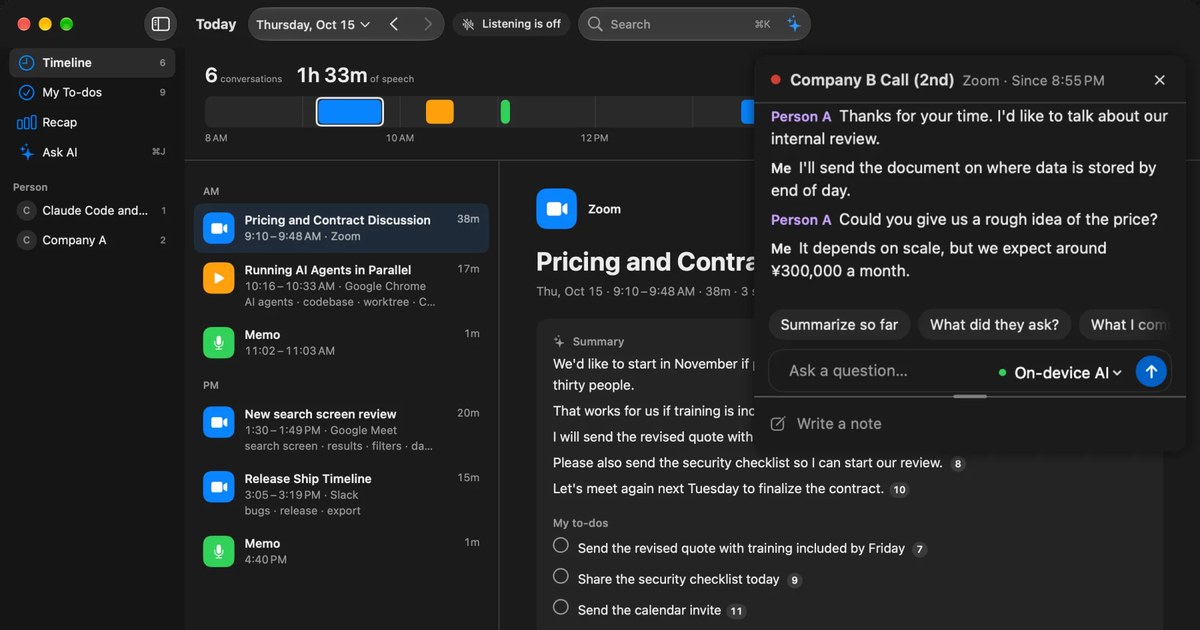
Recall is an app that stays in the menu bar and turns your mic and your Mac’s sound into text. You don’t press a record button. On a call in LINE for Mac, the other person’s voice becomes text as sound from your Mac, and your voice as input from the mic. It works the same for 1:1 calls, group calls, and video calls.
It needs a Mac with Apple silicon on macOS 26 or later, and permission for the microphone and for screen and system audio recording. The screen itself isn’t recorded, but the title of the front window is saved on this Mac with what was said. You choose Japanese or English in settings, and it doesn’t switch automatically during a call.
How speakers are separated
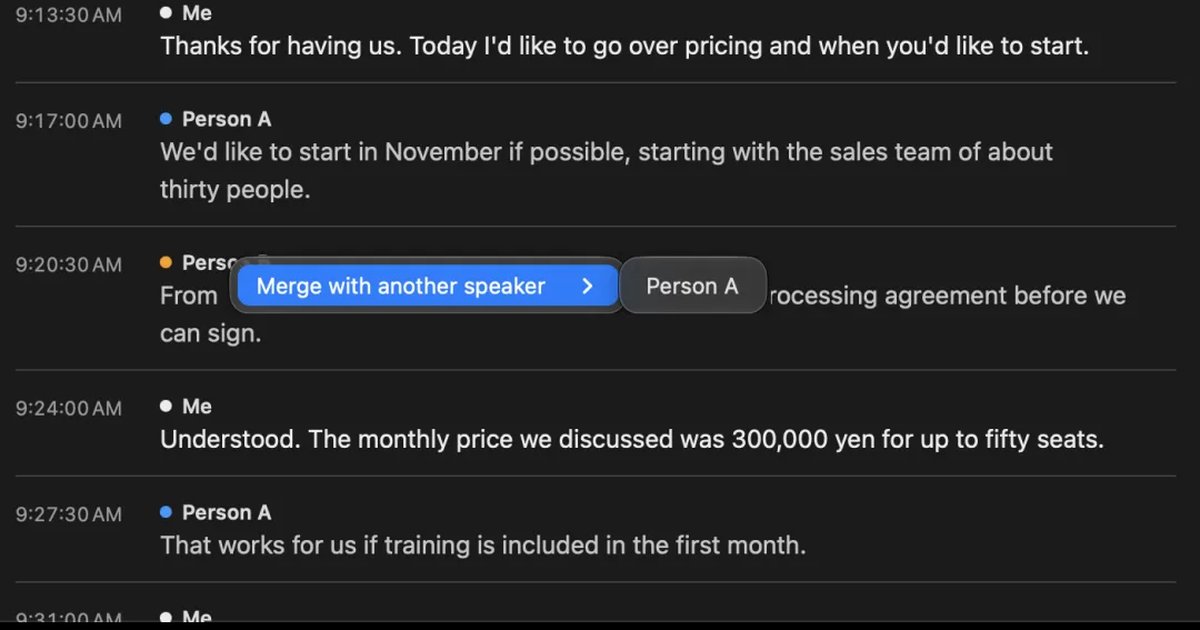
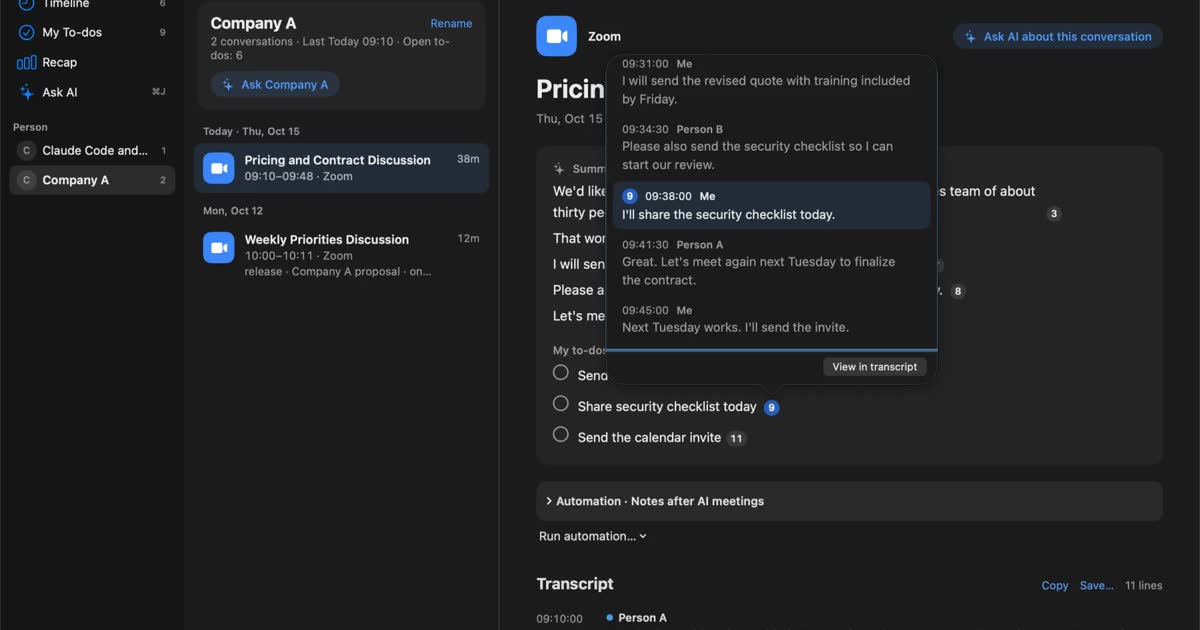
Speakers in the transcript appear as “Me”, “Person A”, “Person B” and so on. Recall doesn’t read LINE display names, so when a speaker has no name or the wrong one, you click a speaker’s name to rename them. A new name applies to every line in that conversation. We haven’t measured how many people it separates well on a group call.
Limits to know first
- It can’t transcribe LINE calls on your phone: Recall is a Mac app. For calls you take on a phone, take them again in LINE for Mac, or use Call Recording
- Only what you heard: Recall transcribes the sound your own Mac hears. Nothing reaches the other person, so to share, you hand over the text yourself
- No audio is kept: Audio is discarded as soon as it’s turned into text, so you can’t listen again in Recall. If you also want audio, use recording on the Mac
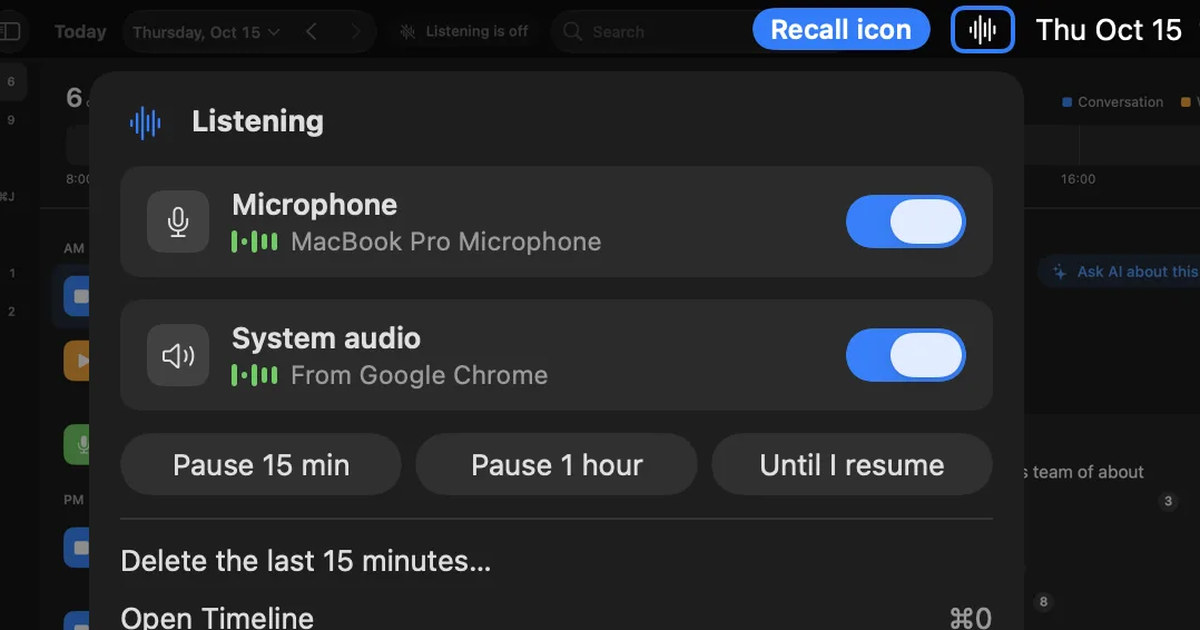
- It listens separately from LINE’s mute: Recall listens to the Mac’s microphone directly, so what you say while muted in LINE is still saved as your own lines. Pause Recall when you don’t want that kept
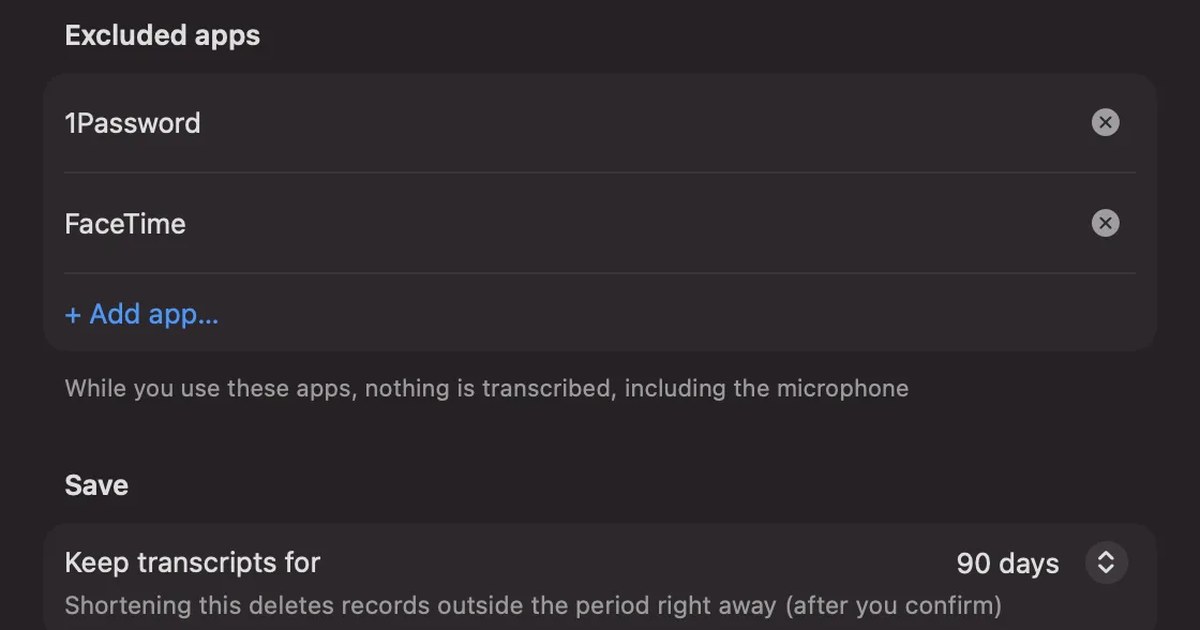
- Other sound becomes text too: If you play a video during a call, its speech becomes text as well. Apps you never want transcribed while you use them, such as banking apps, can be added to Excluded apps
Reading it back and sharing it after the call
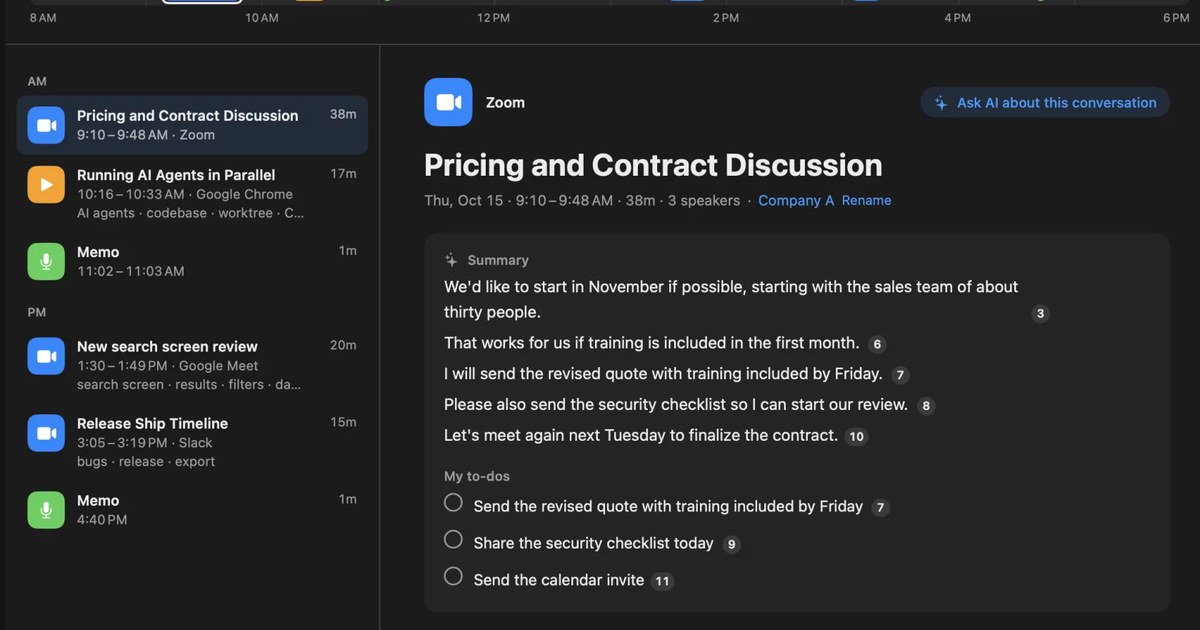
When a call ends, the on-device AI writes a summary, topics, decisions, and “My to-dos”. Summaries and to-dos are made when Apple Intelligence is turned on. Click the number after a sentence in the summary to see the lines it came from.
To share with the other person or anyone else, copy the transcript or save it as a text file, then paste or send it in a LINE chat. This works on Free too. It contains lines of “time speaker: text”, without the summary. When you later want to remember “what time did we agree to meet in last week’s call?”, type words into ⌘K search or ask the AI. By default the on-device AI answers, and neither your question nor your records leave the Mac. On a Mac with less than 16GB of memory, answering questions needs Apple Intelligence turned on.
What’s free, and how long records are kept
Free has no limit on transcription, and shows and searches the last 14 days. Older records are still stored for the retention period and become visible with Pro. Retention defaults to 90 days on Free and unlimited on Pro, and records past the period are deleted. Pro is ¥980 a month or ¥9,800 a year (tax included). If the license can’t be checked for 14 days in a row, Pro features stop.
Records are kept on this Mac, and we don’t send them to our servers. Records leave the Mac only when you use a Pro feature you turned on, or when you copy or save them and hand them over yourself. The list is in When records leave the Mac.
Pause it for calls you don’t want kept
Because the app keeps running, whatever you hear becomes text unless you do something. For calls you don’t want in text, such as casual chats with family or friends, pause from the menu bar. If you notice afterwards, you can remove it with “Delete the last 15 minutes…”.
What to tell the person on the call
Whichever method you use, tell the person on the call that you’re transcribing. LINE’s Call Recording tells the other person by voice and on screen when recording starts. Recall, on the other hand, runs inside your own Mac, so nothing appears on the other person’s screen. Recording first and transcribing later isn’t visible to them either.
That makes a word at the start all the more important. Something like “I’m transcribing this on my Mac so I can look back later. No audio is kept” is enough. Example wording is also in the FAQ. Don’t use it if the other person objects, or if your workplace rules don’t allow it. We don’t recommend recording people without their knowledge, with any product. What to check when choosing AI meeting notes is in What to check if you worry about leaks from AI meeting notes.
Who Recall fits, and who it doesn’t
Recall fits people who take calls in LINE for Mac and want text from them, including group and video calls. If you only want to keep 1:1 voice calls on your phone, LINE’s Call Recording suits you better.
Recall fits you if you
- often use group calls and video calls in LINE for Mac
- want to stop starting a recording for every call
- want to search LINE calls and what you heard on Zoom or YouTube in one place, by word
- want no audio kept and the text on your own Mac
- use a Mac with Apple silicon on macOS 26 or later
Free to use · No account needed · macOS 26 or later · Mac with Apple silicon · By downloading, you agree to the Terms of Service
Recall doesn’t fit you if you
- take most LINE calls on your phone (Call Recording fits)
- want the call’s audio too, to listen again later
- want the app itself to show the other person that you’re recording
- use LINE on a Windows PC
- speak languages other than Japanese and English
Methods for other calling apps are also covered in guides such as How to transcribe Discord calls.
Frequently asked questions
Does LINE have a feature that transcribes calls?
Yes. It’s Call Recording, rolling out in LINE Labs since October 27, 2026. For 1:1 voice calls in LINE on a phone, between accounts registered in Japan, it records and transcribes Japanese speech.
Is it free?
You can try it for free while it’s in LINE Labs. LY Corporation’s announcement says it is planned to become a benefit for LYP Premium members from this winter onward. Recall’s Free plan also has no limit on transcription, and shows and searches the last 14 days.
Is the other person notified when I record?
With Call Recording, both sides hear a voice message that recording has begun, and the screen shows that the call is being recorded. Recall runs inside your Mac, so nothing appears to the other person. Either way, tell them yourself.
Can group calls be transcribed?
Call Recording doesn’t cover group calls. If you join a group call from LINE for Mac, Recall can turn what your Mac hears into text. Tell everyone on the call before you start.
Can video calls be transcribed?
With Call Recording, video calls are only recorded, not transcribed. Save the recording to your device and give the audio to a tool that transcribes files, or take the call in LINE for Mac and transcribe it with Recall.
Can I use Call Recording in the PC version of LINE?
LINE’s user guide covers the smartphone app (iOS and Android) at version 26.16.0 or later and says nothing about the PC version. If you call on a Mac, record on the Mac, or transcribe with Recall.
Are recordings and transcripts lost when I change phones?
According to the user guide, data inside the app is deleted when you change phones, or delete and reinstall LINE. Recordings are sent to Keep Memo automatically, but you have to send transcripts yourself. Send the important ones beforehand.
Checked on November 7, 2026. LINE details come from LY Corporation’s press release (October 27, 2026), the Call Recording page of LINE’s user guide (updated October 28, 2026), and its page on video calls in the PC version. LINE WORKS AiNote details come from its product page. LINE Labs features can change or end without notice, so please check the latest pages before use.
The difference between Recall Free and Pro is in Plans and licenses.
Free to use · No account needed · macOS 26 or later · Mac with Apple silicon · By downloading, you agree to the Terms of Service
Get the product overview (PDF) by email →
Related articles
How to record and transcribe phone calls on iPhone: the notice, where calls are saved, and fixes when it doesn’t work
The iPhone Phone app can record a call from the More button during the call, and saves the audio and a transcript by speaker to the Call Recordings folder in Notes. The steps, the notice the other person hears, reading and summarizing the transcript, the settings and regions to check when it doesn’t work, and what to use for LINE, FaceTime and Mac meetings.
How to record internal audio on a Mac: macOS 27’s built-in option, BlackHole and OBS
On macOS 27 or later, a Mac can record internal audio with built-in screen recording. Steps for BlackHole and OBS on earlier Macs, what to check when there is no sound, and an option if you don’t need audio.
How to transcribe Discord calls: bots vs. your Mac, and keeping meeting notes
Discord has no built-in way to transcribe calls. We compare transcription bots, the recording bot Craig, and Recall, which transcribes what your Mac hears, by who can set them up, DM calls, and where audio and text go.
How to transcribe locally on a Mac: keeping meetings inside your company
How to transcribe on a Mac without sending audio to the cloud. Compare Notes, MacWhisper, Aiko, whisper.cpp, Recall and more, and check the four places records can still leave.
Can you record a FaceTime call? iPhone, Mac, audio, and keeping a transcript
Yes: on iPhone and Mac, Call Recording records a one-to-one FaceTime audio call, and both people hear a notice. Steps, where recordings and transcripts go, why the button may be missing, what screen recording, Live Captions and Live Photos keep for video calls, and telling the other person first.