 Recall
How to transcribe Zoom meetings: built-in, cloud services, or on your Mac
Three ways to transcribe a Zoom meeting: built-in features, cloud services and apps on your Mac. Covers the plans each needs, the May 2026 captions change, and how to choose.
The short answer: free captions alone will not keep your text
There are three ways to transcribe a Zoom meeting: Zoom's built-in features, a cloud service such as Notta, and an app that transcribes on your Mac. If you host on a paid plan, the built-in features are the quickest. If you are not the host, or you want to decide where the text lives, look at the other two. The automated captions on the free Basic plan are for reading during the meeting, and since a May 2026 change they cannot be saved.
This article is written by KOROMO K.K., the developer of Recall. What it says about Zoom, Notta, Rimo and MacWhisper comes only from their official pages. It also says when Recall is not the right choice. It does not say which method is most accurate, because we have not measured them under the same conditions.
| Your situation | What fits, and where to read next |
|---|---|
| You host on a paid plan | Zoom built-in. See the built-in features |
| You are on free Basic and want to keep text | Transcribe a computer recording, or use another app. See what free can do |
| You are not the host | Ask first. See when you are not the host |
| You want to share with a team or read on a phone | A cloud service. See cloud services |
| You want to transcribe without sending it off your Mac | An app on the Mac. See transcribing on your Mac |
How the three ways differ
The three differ in who starts them and where the text ends up. Settle those two points before accuracy or price, and the choice narrows by itself.
| Who runs it | Where the text stays | |
|---|---|---|
| Zoom built-in | The host or an admin sets it up and starts it | The Zoom account, and on your computer if you save it |
| Cloud service | You invite a bot and the host admits it | That service's cloud |
| On the Mac | You run it on your own Mac | Your Mac |
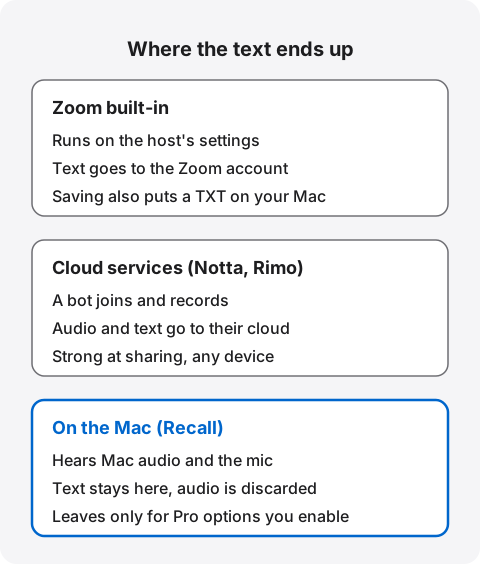
What matters is not which method is safe, but which suits your meetings. Zoom's Terms of Service say it does not use audio, video, chat and similar customer content to train Zoom or third-party AI models. Some cloud services store data in Japan. An app on the Mac, for its part, makes managing and deleting the data your job. If the Mac's encryption or password is weak, that becomes the weak spot.
The other angle is what the other people can see. Zoom recordings show a notice, and a bot appears in the participant list. An app on the Mac does not join the meeting, so nothing appears on anyone's screen. That is why you tell them yourself. See how to tell the other people.
Transcribing with Zoom's built-in features
Zoom transcription is not one feature but five, with different purposes. Their names are similar, and mixing them up is how people end up saying "I heard it was free, but nothing was saved." The plans they need are as follows.
| Plan needed | What is kept | |
|---|---|---|
| Automated captions | From Basic (free) | Nothing. You can scroll back 3 minutes during the meeting |
| Meeting transcript | Pro, Business, Enterprise | A transcript. Save it as TXT from the panel |
| Cloud recording audio transcript | Pro, Business, Education, Enterprise | The recording and a VTT file |
| Meeting summary | The pricing table shows 3 hosted meetings a month on Basic, unlimited on paid plans | A summary |
| My Notes | Pro, Business, Enterprise or a standalone plan. The pricing table also shows 3 uses a month on Basic | Your notes and transcript |
On the pricing page, Pro is $16.99 per user per month billed monthly, or $14.16 billed annually (the US dollar display checked on the date below).
Automated captions: for reading during the meeting
Automated captions turn speech into subtitles on the spot. They appear on the free plan page, which says they are "also known as live transcription." That wording is the source of the confusion. Japanese and many other languages are supported, and you turn them on from the toolbar, unless the host has disabled them.
A big change came in 2026. Zoom's announcement says captions and transcripts were separated in a rollout from May 24 to 26, 2026. You can scroll back through captions for 3 minutes during the meeting, but you cannot keep them afterwards. Treat older instructions for saving captions as no longer working.
On supported devices there is also a setting that processes caption audio on the device. It needs the Zoom desktop app 6.5.3 or later and, on a Mac, Apple silicon M2 or later. It keeps captions steady on weak connections. It does not keep the text.
Meeting transcript: the standard way to keep the text
Meeting transcript is the feature provided to keep text in place of captions. It is off by default, and you turn it on like this.
- Sign in to the Zoom web portal and open your settings. On an organization account, check with your admin.
- Under Meeting, in In Meeting (Advanced), turn on Meeting transcript.
- If it is grayed out, an admin has locked it and you cannot change it.
- In the same place, choose whether participants can view it and who can save it to a computer.
In the meeting, choose More, then Transcript. A panel opens on the right, and Save transcript at the bottom writes a TXT file. On a Mac it goes to /Users/[Username]/Documents/Zoom.
You can limit saving to the host, the host and co-hosts, participants who are not guests, participants on given IP addresses, or everyone. Admins can also delete transcripts after a set number of days (up to 9999) and show a notice to participants when transcripts are on. Review these before any meeting with outside people.
Cloud recording audio transcript: kept with the recording
If you also want the video, you can add a transcript to a cloud recording. Turn on Create audio transcript in your Recording settings, and after the recording is processed, a VTT file appears in the list of recordings. You get an email when it is ready. You can correct text and add speaker names in the web portal, and search for words across recordings. When you share a recording, you choose whether viewers see the transcript.
Two cautions. It works only with cloud recordings, not recordings saved to your computer. And it is not instant. The pricing page shows 10 GB of cloud storage per user on Pro, so check the space if you keep video. If you do not need a recording, Meeting transcript is the lighter choice.
Meeting summary and My Notes
If you want the main points rather than every word, there is Meeting summary with AI. The host starts it and the summary arrives after the meeting. Its supported languages include Japanese, and Zoom says it may use third-party models. The help page lists only paid plans as requirements, while the pricing page shows 3 hosted meetings a month on Basic, so check your own account. It does not work inside breakout rooms.
My Notes adds a transcript to your personal notes, and works for in-person and third-party meetings as well as Zoom. It uses the microphone and system audio. In a Zoom meeting, the My Notes and transcription icons light up at the top right for participants, and the host can stop it. In a third-party app, that app's mute button does not stop transcription, so stop it in My Notes.
Which built-in feature to use
On a paid plan, choose by what you want to keep. For text only, use Meeting transcript, which is enough for a regular meeting that needs no recording. For training sessions and briefings you will watch again, use the cloud recording audio transcript. To pass decisions around without the full text, use Meeting summary. For your own notes that you will not hand out, use My Notes.
If you combine them, watch how you stop them. The My Notes help says that when the host stops transcription, features that rely on it, such as summaries and in-meeting questions, stop too.
Turning a transcript into minutes
The text you get is not yet minutes. An audio transcript is a VTT file split by timestamps, which opens in a text editor or word processor. Zoom's help says capitalization and punctuation are not included, so you add them by editing. Lines from an unidentified voice show as Unknown Speaker, and you can type the name in. A TXT saved from Meeting transcript is likewise a record of what was said, not an organized list of decisions.
To make minutes, pull out three things first: what was decided, what happens next and who does it, and by when. If you ask another AI to do that, what you paste goes to that AI's provider. Check your workplace rules before pasting a transcript that contains what outside people said.
Where Zoom transcription trips people up
People usually get stuck on four things: what the free plan covers, English output, what non-hosts can do, and forgetting to save. All of them are avoidable once you know how the features divide.
What free can and cannot do
We found no built-in way to keep a full meeting transcript on free Basic. Automated captions cannot be saved, and Meeting transcript and the audio transcript require Pro or above. The pricing page lists 3 summaries and 3 My Notes uses a month on Basic, so if the main points are enough, check your own account. Basic meetings run up to 40 minutes.
The recording that free accounts can use is recording to your computer. Zoom does not transcribe that file, so you transcribe it with another app. It takes two steps, but it is a practical way to handle a recording you already have. It needs the Zoom desktop app, and it does not work on phones.
When the transcript comes out in English
Cloud recording audio transcripts are generated in English by default. If a meeting in another language came out as strange English, change the language and regenerate it.
- Open Recordings & Transcripts in the web portal.
- Open the meeting from the Cloud recordings tab.
- Hover over the Audio transcript file and click Change Language.
- Choose the language and save. Zoom reanalyzes the audio.
Zoom's help pages disagree here. The usage page lists 19 languages including Japanese, while the settings page still says English only. Test with a short recording before relying on it. Captions are separate: in the desktop app the default language follows the host's operating system language, and in the web app it is English.
When you are not the host
A participant cannot start Meeting transcript or recording alone. You ask the host. Choosing Transcript shows Request transcription, and the host starts it or declines. Recording works the same way: the host must record or grant the ability to record. My Notes may be available to participants, and the host can stop it.
A short reason helps: "I'd like to keep an accurate record. Is it OK if I use transcription?" Even when it feels awkward to ask in an outside meeting, do not quietly record another way. Some organizers do not allow recording or note-taking at all. Confirm that first, before choosing a method.
When you forgot to save
If transcripts are kept with summaries, the host can open and download them afterwards from the Transcripts tab in Recordings and Transcripts. Text from a meeting where only captions were on cannot be recovered. If you forget the button, there is a setting to generate transcripts for all meetings automatically, and admins can keep it always on for the organization. With an app that runs in the background, like Recall, there is no saving step at all unless you have paused it.
Getting better transcripts
With any method, poor audio means poor text. Zoom's help suggests the following.
- Keep background noise down
- Speak clearly into the microphone
- Avoid shuffling papers and typing loudly
- Place the microphone near the people speaking
- Choose an external microphone over a built-in one
Zoom also warns that automated captions may not be accurate. Check numbers and names at the end of the meeting.
Using a cloud service
With a cloud service, you invite a bot to the Zoom meeting, it records, and you read the text in the service. The Notta and Rimo bot help pages state no paid Zoom plan as a condition. Sharing and editing are well developed. In exchange, the recording and text sit in the service's cloud, and the host has to approve the bot.
| How it works with Zoom | What to check | |
|---|---|---|
| Notta | Paste the invite URL and Notta Bot joins. Saved to your workspace | Free is 120 minutes a month, 3 minutes per session |
| Rimo | Enter the URL and a bot joins in a few minutes. It can also import Zoom recordings | Pro is ¥4,950 a month (monthly billing, tax included) |
Notta's help says that on Zoom, beyond waiting room admission, there is a second approval for recording that the host cannot skip. Local recording by external participants must also be allowed in Zoom's settings, and webinars are not supported. If the host does not admit it within 5 minutes, the bot leaves. It stops by itself when no other participants remain or at the 5-hour maximum. In a meeting you do not host, arrange this in advance. Rimo's bot also needs to be admitted.
Their strength is what happens after the meeting. Notta transcripts can be read on the web or in the mobile app and passed on with a share link. A team reading the same record is hard to do with an app on one Mac. Notta Premium is ¥1,980 a month (monthly billing, tax included) for 1,800 minutes. Rimo's pricing page describes storage in Japan and no AI training on your data.
What to confirm is storage and training. Notta keeps data until you delete it, and how speech recognition training is handled varies by plan. There is more in our Notta comparison, and how to check meeting AI in general is in our data safety guide. If you simply do not want a bot, Notta also has bot-free recording, but that is processed online. Whether a bot is present and where the audio is processed are separate questions.
What to check before choosing a cloud service
- Host approval: In meetings you do not run, can you ask for the bot to be admitted and allowed to record?
- Limits: Do the monthly minutes and session length cover your meetings? Compare the numbers, because free tiers are often short.
- Storage and deletion: How long does data stay if you do nothing? Which plan has automatic deletion?
- Training: Is your audio or text used to train AI? Which plans opt out?
- Sharing: Can share links go outside your organization? Can an admin stop that?
- Export: Can you take the text with you when you leave? Notta downloads start at Premium.
Transcribing on your Mac
An app on the Mac transcribes the other people's voices from your Mac's audio and your own from the microphone, on that Mac. Your Zoom plan and the host's settings do not matter, so even a participant on Basic can keep text on their own Mac. You still need to confirm that recording notes is allowed.
There are limits. If you are not using that Mac for the meeting, nothing is kept. Meetings joined on an iPhone are not covered. Sharing means handing over a file yourself, and you cannot read it on other devices. Here are two apps that take different approaches.
Recall: runs in the background and keeps only text on your Mac
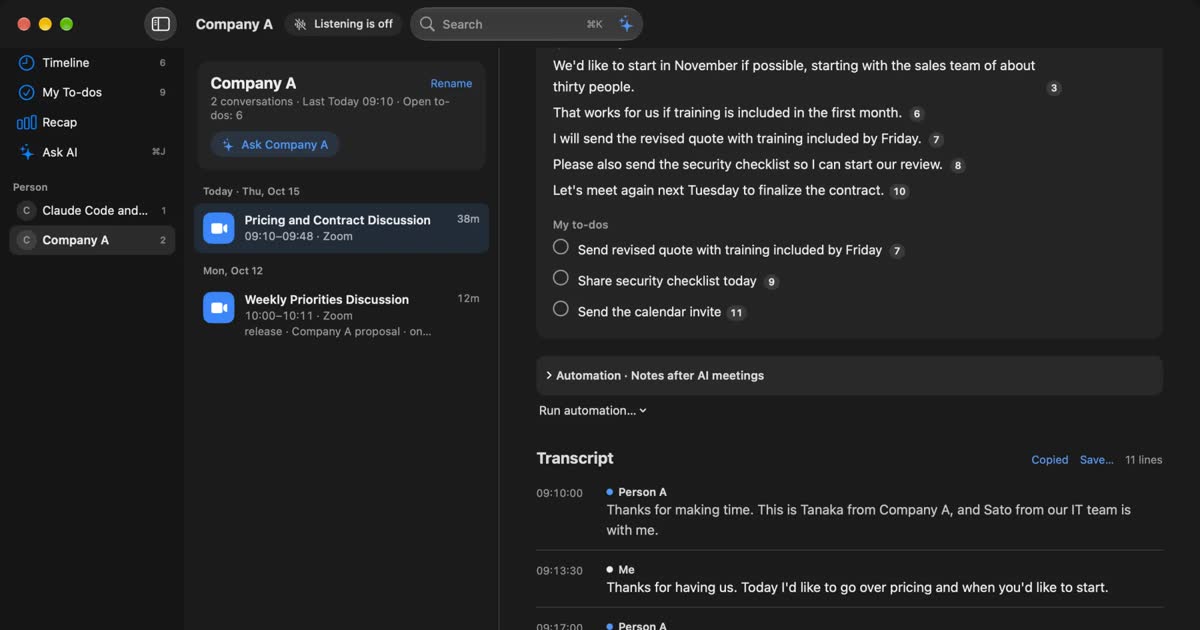
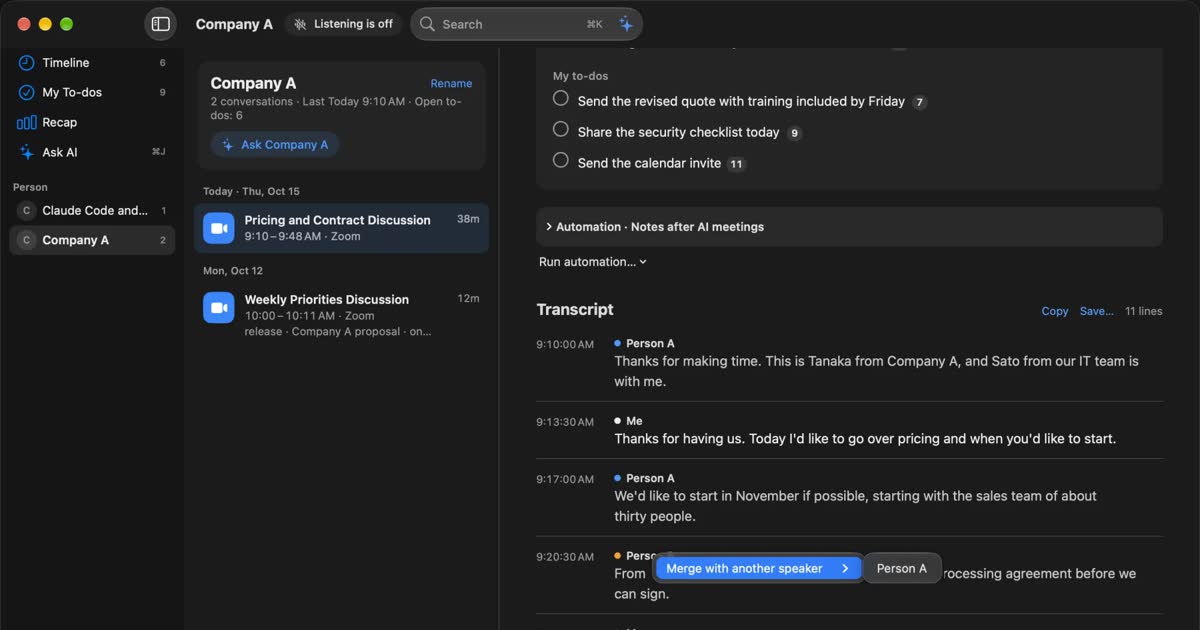
Recall sits in the menu bar and transcribes the conversations it hears, with no record button. It does not join the Zoom meeting as a participant, so there are no host settings or bot approvals. Once installed, it handles Zoom and other meetings the same way.
- No audio is kept. It is discarded as soon as it becomes text. Transcripts and summaries stay on this Mac.
- Other people appear as Person A, Person B. Click a speaker's name to change it across the conversation.
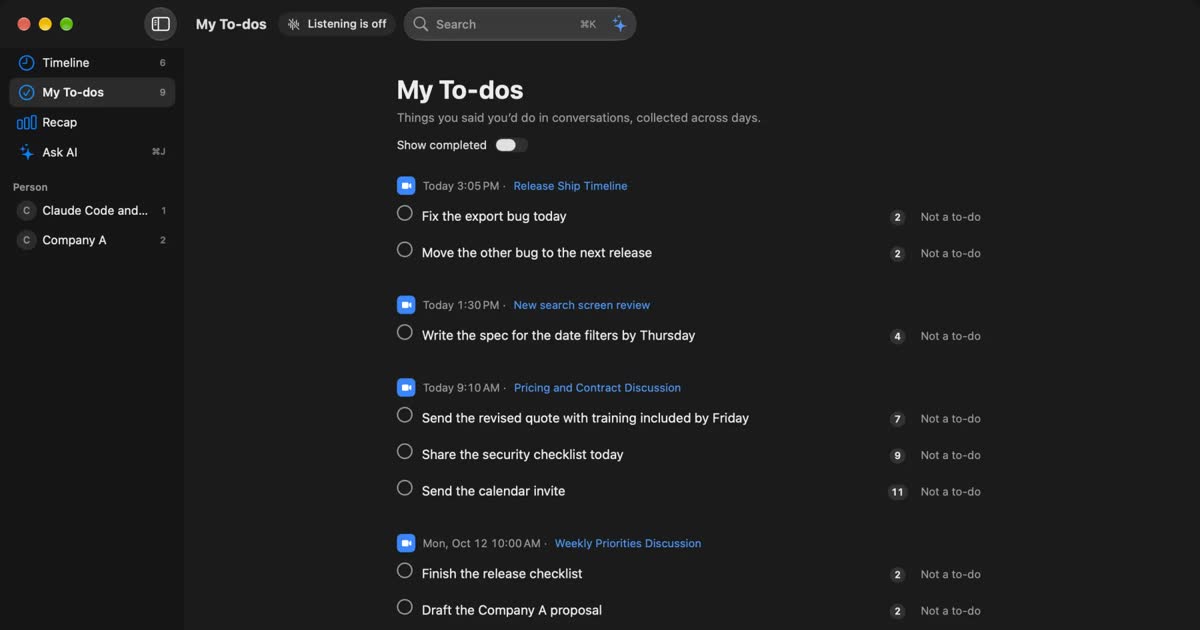
- The on-device AI writes summaries and to-dos. Sentences carry numbers that link to the remarks behind them.
- You can search past conversations. Use ⌘K with conditions such as "yesterday" or "Zoom", or ask the AI.
- Text can be saved as TXT. Copy one conversation with times and speakers, or save it as a file.
The conditions, up front. It runs only on Macs with Apple silicon on macOS 26 or later. Summaries and to-dos are made when Apple Intelligence is on, whatever the memory (except when you choose an outside AI for organizing meetings on Pro). Answers to questions need Apple Intelligence on only on Macs with less than 16 GB of memory. Free has no transcription limit, but viewing and search cover the last 14 days. Records are kept 90 days by default on Free and indefinitely on Pro. Pro is ¥980 a month or ¥9,800 a year (tax included), and Pro features stop if the license cannot be checked for 14 days.
It is also not true that nothing ever leaves the Mac. Part of your records leaves only when you use Pro features you turned on, such as answers from your own Claude or ChatGPT, or outside AI tools reading your records. It also connects to get the model, check the license and check for updates. The full list is in Privacy and data.
In meetings, it helps to know how audio is handled. Recall tries not to record the other person's voice from your speakers as your own, but earphones are the most reliable. If your voice and theirs mix in one remark, it may be kept as yours. If the talk turns to something you do not want kept, pause for 15 minutes or an hour with one click, or delete the last 15 minutes afterwards. You can also exclude apps such as banking apps.
Because no audio is kept, you cannot listen again to check. For content where a misheard word matters, use another method where recording is allowed. You also need to grant microphone and screen recording permission first, which a managed work Mac may block.
MacWhisper: transcribes audio files on your Mac
MacWhisper transcribes audio and video files with models on your Mac. You can give it a Zoom computer recording, so it suits people who already have recordings. It also records meetings without bots, though its pricing table puts that in Pro, a one-time €64. It differs from Recall in keeping the recording, which is an advantage if you want to listen again. See our MacWhisper comparison, and local transcription on a Mac for the wider picture.
How to choose
If you are unsure, go through these four questions in order. The first that applies is the option with the least effort.
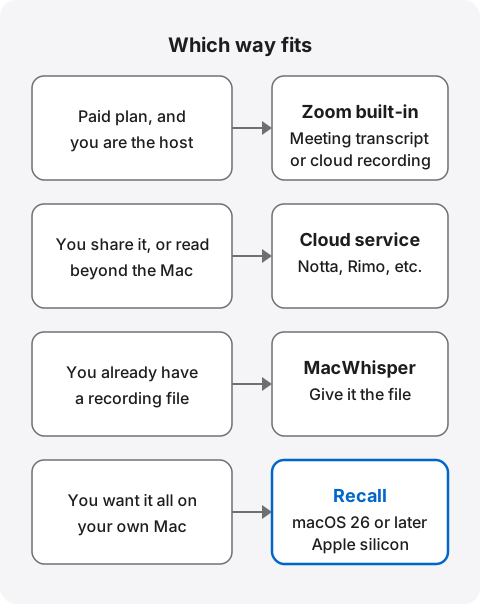
If you host a weekly internal meeting on Pro, there is little reason to add anything. Turning on Meeting transcript is enough. If a team reads the same record, a cloud service is the natural choice. If you are usually invited to other companies' Zoom meetings, you cannot run Meeting transcript or recording yourself, so an app on the Mac becomes a candidate once you have confirmed with them.
Think about cost in people and hours. Zoom is priced per user, so count the people who host. Cloud services cap minutes, so count your monthly meeting hours. An app on the Mac assumes you have a supported Mac. If you join from Windows or an iPhone, that option is out.
Examples by situation
| What fits | Why | |
|---|---|---|
| A regular internal meeting you host on a paid plan | Meeting transcript | No extra contract, and you can set how long it stays |
| Training or briefings you will watch again | Cloud recording audio transcript | The video and text stay together |
| Sales calls a team reviews together | A cloud service | Built around sharing and editing |
| Meetings another company hosts | An app on the Mac, after asking the organizer | You cannot run Meeting transcript or recording yourself. My Notes may be available to participants, and the host can stop it |
| Listening to a Zoom webinar | An app on the Mac, unless the event notice prohibits recording | Notta's bot does not cover webinars, and Mac audio can be heard |
| Past meetings you have recordings of | An app that takes files | Recall cannot import past recordings |
Combine them instead of picking one
You do not have to keep every meeting the same way. You might use Meeting transcript for internal meetings you host, a cloud service for sales calls the team reads, and an app on the Mac for everyday conversations. For participants who are hard of hearing or meetings that are hard to follow, Zoom's automated captions work alongside any of these unless the host has disabled them. They do not stay, but they help in the moment.
Just avoid recording the same meeting twice. Two copies mean one may survive when you delete the other, and explaining it to people gets complicated. Pick one for each meeting and tell people about that one.
Rough yearly cost
Here is what you would pay for transcription alone. Zoom Pro also covers meeting time and recording, so if you already subscribe there is no extra cost.
| Per year | Terms | |
|---|---|---|
| Zoom Pro | $169.92 | Annual billing, $14.16 a month per user × 12 |
| Notta Premium | ¥14,220 (tax included) | Annual plan, up to 1,800 minutes a month |
| Rimo Pro | ¥59,400 (tax included) | Monthly ¥4,950 × 12 |
| MacWhisper Pro | €64 | One-time purchase |
| Recall | Free ¥0, Pro ¥9,800 (tax included) | Free has viewing and search for the last 14 days |
Price alone does not decide it. Cloud plans include sharing and team features, and Recall has no sharing. Check that you are not paying for what you will not use.
Who Recall suits
- People who do not want to set anything up or press start for each meeting
- People often invited to other companies' Zoom meetings, who cannot rely on host settings and can tell the other people
- People who want only text on their own Mac, with no audio kept
- People who want to search Zoom together with other meetings and videos later
- People on a Mac with Apple silicon running macOS 26 or later
Free to use · No account needed · macOS 26 or later · Mac with Apple silicon · By downloading, you agree to the Terms of Service
Who Recall does not suit
- People who join Zoom from Windows or an iPhone
- People who want the audio or video itself. Recall does not keep audio
- Teams that want to share records. Recall has no sharing, so you hand over text as a file
- People who want to transcribe audio files they already have
- Paid Zoom hosts for whom the built-in features are enough
How to tell the other people
Whichever method you use, tell people it is being transcribed. With Zoom recordings, participants are asked for consent, and recording notifications cannot be disabled. Admins can show a notice for transcripts, and a bot is visible as a participant. Even so, say it in words rather than relying on what is on screen.
An app on the Mac has nothing like Zoom's notice. Nobody can see it, so telling them is on you. The Recall site suggests wording like this.
I'm transcribing this on my Mac so I can check the details later. No audio is saved, but the transcript stays on my Mac. Let me know if you'd rather I stop.
With a bot or cloud service, say "I'm using a transcription service, and the record is stored in [service name]." If you send meetings to outside AI or remember other people's voices, tell them that too. Do not use any of these where recording or note-taking is prohibited, or where your workplace rules do not allow it. Whether rules cover transcription differs by company, so ask if unsure. Some places require everyone's consent. This article is not legal advice.
For use at work, decide three things before you start: which meetings to transcribe, where the text lives and who can read it, and when it is deleted. In Zoom you can set the deletion period and who can save. In Recall you can choose a retention period from 7 days to indefinite, and delete conversations one by one.
Frequently asked questions
Is Zoom transcription free?
Free Basic gives you automated captions to read during the meeting. Meeting transcript and audio transcripts, which keep the text, require Pro or above. On free, transcribe a computer recording with another app, or use an app that transcribes on your Mac.
Where are Zoom transcripts saved?
Save transcript in a meeting writes a TXT file, on a Mac to the Zoom folder in Documents. Cloud recording audio transcripts appear as VTT files in Recordings & Transcripts in the web portal.
I cannot find the option to save captions.
The Save captions setting was removed in the May 2026 change. Captions cannot be kept after a meeting. Turn on Meeting transcript to keep the text. Older instructions were written before this change.
My meeting is not in English, but the transcript is.
Cloud recording audio transcripts default to English. Open the recording in the web portal and use Change Language on the Audio transcript file to regenerate it. If that does not work, ask Zoom.
Can someone other than the host transcribe?
For Meeting transcript and recording, you ask the host. With Request transcription, the host starts it or declines. My Notes may be available to participants, and the host can stop it. Apps on the Mac run regardless of host settings, but ask the organizer whether recording notes is allowed first.
Can other people tell it is being transcribed?
It depends. Zoom recordings ask for consent, bots are visible as participants, and My Notes lights up an icon. An app on the Mac shows nothing on their screens. Whichever you use, tell people it is being transcribed.
Which method is the most accurate?
We have not measured them under the same conditions, so this article does not compare them. Zoom recommends reducing noise and speaking close to the microphone. Trying each on your own short recording or real meeting is the surest way.
Do these methods work with Google Meet or Teams?
Zoom's built-in features work only in Zoom. Notta's bot supports Zoom, Teams, Google Meet and Webex. Recall listens to the sound from apps shown in the Dock, so it does not depend on the meeting app. You still need to ask the organizer. For Teams, see how to transcribe Teams meetings.
Does Recall need any settings in Zoom?
No. Grant your Mac's microphone and screen recording permissions and it hears Zoom's audio. Recall guides you through this on first run. It runs only on Macs with Apple silicon on macOS 26 or later.
Checked on November 2, 2026. Details of Zoom come from the text of its official help on the captions and transcript update, Meeting transcript settings and audio transcripts, among others, with plans and prices from its pricing page. Notta and Rimo prices are from their official pages, checked the same day. Yearly figures are calculated from the listed prices. Zoom's features, prices and screen names change, and the prices shown vary by region, so check the official pages before relying on them.
Free to use · No account needed · macOS 26 or later · Mac with Apple silicon · By downloading, you agree to the Terms of Service
Get the product overview (PDF) by email →
Related articles
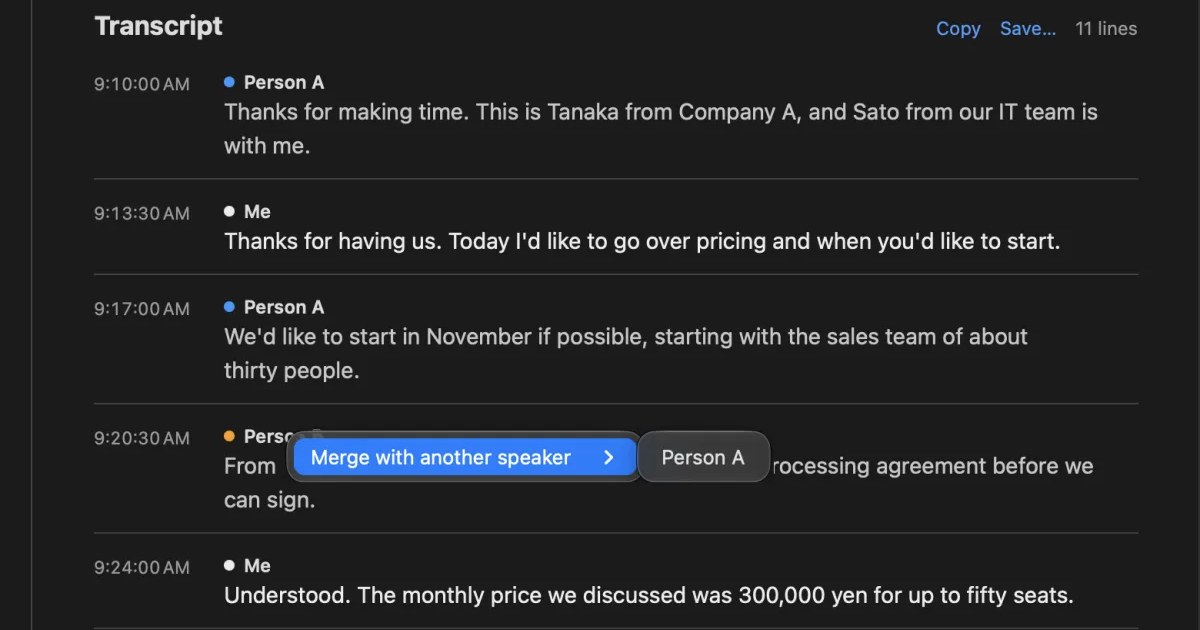
What is speaker diarization? Splitting a transcript by who spoke, and fixing it when it goes wrong
Speaker diarization splits audio by who spoke when and labels each speaker with a number such as Speaker 1 or Person A. How it differs from speaker identification, how Teams, Zoom, Word and do-it-yourself tools split speakers, why in-person meetings split badly, and how to rename and merge speakers.
tl;dv alternatives compared: when you do not want a bot in the meeting
For people looking for a tl;dv alternative. We compare the bot and bot-free recording, where the record goes, free limits and pricing, and who should stay on tl;dv and who fits Recall.
How to automate sales call notes: what to keep, what to say, and your CRM
A guide for sales and customer success. What to keep in call notes, phrases for telling the other side, how notes relate to your CRM, and how to choose among tools such as Notta and amptalk.
Real-time transcription: free ways on your computer, phone, and in meetings
Free ways to get real-time transcription: live captions on Mac, Windows, iPhone and Android, Zoom, Teams and Google Meet captions, and apps, compared by whether the text is kept and whose voice they hear.